Iguazu Falls: One of the seven wonders of the world

For those of you mostly skimming and looking for pictures, check out the albums I’ve uploaded so far to Google Plus. It’s a slow process with wifi connections on my very old, slightly fussy laptop, but most of them are up, and slowly but surely I’ll get the rest up too!

I can’t believe I just spent the last two days at a place that has been named one of seven wonders of the world. I’ve been looking at pictures of and reading about Iguazu ever since Alison and I first started flirting with the idea of traveling together almost 3 months ago, and it’s almost unreal that I’m now here, and that my time traveling with Alison and her sister is officially over tomorrow afternoon.

Iguazu is incredible — the falls literally take your breath away, the cheesiest cliche ever, but totally true. Their enormity, the power of the water, and the sheer number of waterfalls in one area is truly astonishing. Words can’t really do them justice, nor can my pictures, but you just have to believe me, and add Puerto Iguazu to your list of places to visit one day.

With the whole bed bug discovery disaster during our last night in Buenos Aires, we were a bit hesitant to see how the last minute hostel that we booked 10 hours prior to our arrival would work out. Despite our taxi driver getting turned around several times and mostly lost before finding the place (exactly like every single TripAdvisor review told us would happen, yet totally unavoidable since she SWORE up and down she knew exactly where it was), we made it out to our hotel. The property is really beautiful, and worked out perfectly. Our original plan was to stay here one night and then find another place for the next two nights closer to the downtown area, but we decided we loved it and stayed the whole time, and it has worked out great!

The property is owned by Lorena and her partner Andrea, and is a few bungalows with different bed set ups, and then a main kitchen/living room area in a separate bungalow. Lorena is so, so sweet — she is genuinely concerned and interested in everything, and though she is a total chatty Cathy, she has really wonderful stories and great things to explain to us. Plus she serves a mean breakfast, with great huevos!

On our first day, we arrived here and put our stuff down, then took the bus into the downtown area for some late lunch of delicious empanadas and then wandered through the touristy gift shops. Then we met Lorena, went the grocery store so we could make ourselves lunch for our days in the park, then hitched a ride back to the hotel with her. We spent the rest of the evening relaxing, catching up on emails/Facebook, and ordered in pizza. A perfect night in after many nights of travel!

Yesterday was our first day in the park, and despite setting an early alarm, we managed to dismiss it and sleep til 9:30, so by the time we had breakfast, made sandwiches for lunch and got on the bus to the park, it was past noon. Oops!

We spent the day wandering the “lower circuit” trail, which gives a view of the falls from below, but from a distance.  The park itself is much more developed than the three of us realized it would be. The paths are all metal walkways built over the ground/waterfalls/rivers, and most everything in the park is handicap accessible, which is very impressive. We anticipated more intense hiking, but we walked slowly and took the views in, although our feet were definitely achy by the end of the day. Since the lower circuit took less time than anticipated, we walked to the “devils throat,” or Garganta del Diablo, and then did the upper circuit, which gives you views of the falls from directly above/on top of them.

Having just been to Niagara falls a few months ago, I had that beauty to compare these falls to, and Iguazu definitely blows Niagara out of the water (pun intended?). It’s pretty difficult to put into words the enormity of the falls, but the Garganta section is farther back and removed, and then at least another dozen or so falls line up along a gigantic cliff, shooting hundreds of thousands of gallons of water out into the basin. Every time you see them, you just can’t stop staring — they’re so enormous, and so beautiful, it’s almost ridiculous.

Today we did a separate, less popular, hike to a much smaller waterfall more removed from the main falls. Though we expected something a bit more strenuous, the walk was really beautiful and we saw tons of wildlife, including birds, butterflies, and adorable monkeys. Speaking of wildlife, there are hundreds of coati that live in the park — an animal that looks like a cross between an anteater and a raccoon. They appear fuzzy and adorable but will literally walk right up to humans and chase them in an attempt to get food. We couldn’t eat lunch in certain areas of the park because there were so many of them begging for whatever food they could get. So sad to see how they’ve evolved to be completely unafraid of humans, despite the dozens of signs warning not to feed them.

After our walk, we went back to the main falls to book a boat tour that brings you right up to the base of the various falls. We knew we’d be getting soaked (as we were told to wear ponchos and place our backpacks in gigantic waterproof bags), but didn’t quite realize how close to the falls the boat would actually take us.

I was hesitant to fork over $150 pesos ($35 bucks is a lot for a 12 minute boat ride, and we already had to pay an $130 peso entrance fee to the park yesterday, plus another $65 pesos for entry today) for the boat ride, but decided it was a once in a lifetime experience and being a little wet, and very cold, for an hour or so wouldn’t be the end of the world.

The best part of the boat ride might have been when Alison turned around, absolutely terrified, and screamed “terminado” to the boat driver who, after grinning, drove the boat right back up to another waterfall, which sufficiently soaked us for the second time.

The most incredible thing about the boat ride was how powerful the falls felt from their base — the amount of water crashing 200 feet down the side of a cliff is hard to understand and capture when you’re taking photos from so far away all day, so being sprayed and soaked completely from the base of so many waterfalls was a pretty humbling experience.

After our boat ride adrenaline rush, we spent a few minutes relaxing in a view of the falls, and then left the park by bus to go  to the downtown area of Puerto Iguazu for dinner. Now we’re back relaxing at the hostel, snuggled in our PJs. Originally when we booked this leg of the trip, we’d heard it was slightly impossible and very expensive to obtain a visa to get to the Brazilian side of the falls (Iguazu is like Niagara falls — you can view them from both Brazil and Argentina, like you can view Niagara from NY and Canada) but when we got up here, our taxi driver told us that Brazil had gotten more relaxed about letting people in without stamping their passports/asking for a visa. Of course this got our hopes up, but every person we asked had a different thought/opinion/confusion about whether we could get there, and we weren’t interested in paying the $160 reciprocity fee to Brazil, plus a second park entrance fee. So instead, we just decided to skip it and not bother wasting our time (and money on a cab or bus) getting to the border only to discover they wouldn’t let us in.

It’s almost impossible to believe that my flight back to Buenos Aires is tomorrow afternoon — I have 16 hours in BA before I fly back to Santiago for 24 hours of relaxing, then from there I fly to Peru and start the next leg of my trip! I’m sad to think that my time traveling with Carolyn and Alison is over — it has been so great having friends who speak the language and who can help me adjust to a brand new hemisphere, since both of them have traveled rather extensively in South America. At the same time, I’m also excited to be traveling on my own — I’ll be on my own timetable, not relying on other people, doing exactly what I want, when I want, and really enjoying some time with myself. I’m still a tad nervous (mostly about walking around by myself and having to take taxis on my own) to travel without friends, but I know that it will all work out totally fine, and that even if something disastrous does end up happening, it won’t be the end of the world. Plus, I really just cannot wait to see Machu Picchu!

Livin’ like a gaucho

In Spanish, the word for cowboy — a man who lives on an Estancia (a ranch or cattle farm) — is gaucho. And in order to experience the gaucho lifestyle, we decided to check out life on an estancia for a few days.

Alison and her sister had mentioned that staying on an estancia was a common thing for South American travelers, but that they were pricey to stay on for several nights, or often required boarders to work long hours during the day, so we were talking about the possibility of going horseback riding for just a few hours on an estancia instead. When I went to look at Colonia del Sacramento hostels and I sorted HostelWorld by most highly rated, I stumbled upon El Galope — an incredible sounding ranch in the same county as Colonia, just an hour east, two hours west of Montevideo. They had incredible ratings on several sights and were very, very reasonably priced considering the other options, so we decided to commit to one night there, and one night in Colonia.

Once we arrived at El Galope on Sunday morning, we were instantly infatuated. First of all, as much as I love city travel and exploration, it’s stressful. There’s so much to do and see,, you can really stress yourself out trying to jam pack it all in. You want to see everything, plan it all out and get directions, which is just… a lot. Not to mention cities are pricey, and our wallets were feeling a bit empty from 11 days of eating out two meals a day. We were all so happy to be out in the middle of nowhere with gorgeous, smog-free skies and chirping birds, not to mention the adorable german shepherd, 3 cute cats (a lot coming from me), and 5 gorgeous horses that belonged to the estancia owners, Monica and Miguel.

The day we arrived we spent a bit of time exploring the property, then rented 3 bikes to ride down the road a few kilometers to a goat farm, where we were hoping to purchase some goat cheese. The bikes weren’t exactly in great condition, and the road was both very bumpy and hilly, so the ride was a bit of a struggle. It was my first time on a bike in probably a decade, and sans one accidental instance of almost hitting a tree, I was able to manage riding, which is a good thing, especially considering I am mountain biking on my Machu Picchu trek!

Unfortunately, Victoria was nowhere to be found at Victoria’s goat farm, but 7 stray dogs which she has taken in greeted us at the farm, barking and begging for attention. A soft spot for puppies had developed in all of us, so we made friends and hung out with the dogs and checked out the goats before making our way back to El Galope.

We relaxed for a few hours, read and had some downtime and then had an incredible dinner of cheese fondue and tomato and rice salad. The colony of Colonia was settled by the Swiss, German and Italian immigrants of the 1800’s, and Colonia is a famous cheese producing area. The cheese in our fondue was made at farms in the immediate area, just a few kilometers from where we sat. Delicious! We also had homemade merlot, made by a neighbor whose hobby is making wine, but who only bottles wine for his friends, and El Galope is lucky enough to get a few bottles a month from him. We had some truly incredible dinner conversation with Miguel and Monica — they are both from Uruguay but moved around and lived abroad for nearly 15 years, in Davis, California, Buffalo, New York, and then in a southern city in Germany. They speak English, Spanish and German, and their children are 17 and 18, and live in Montevideo, where the two of them live part time as well. We talked about American and Uruguayan politics, about the South American dictatorships, about their experiences living abroad, their children, and even the amazing 77-year old president of Uruguay.

Their farm was so picturesque — the animals were beautiful, the land was gorgeous, and even though winter approaching meant it was bone-chilling cold, we decided to spend a second night on the farm and head out to Colonia first thing in the morning on Tuesday. We just couldn’t resist!

The next day was cloudy and rainy on and off, so we weren’t able to go horseback riding like we had initially planned. It was great to sleep in though and spend the day relaxing — Monica drove us into town, which was 6 miles from the farm and much, much bigger than we expected. We wandered, bought some groceries to cook ourselves a veggie egg scramble for lunch, and then she drove us back. After lunch, we decided to brave the very cold, windy, and overcast weather and take a walk, so we wandered down a nature trail for several hours — checked out some beautiful birds and a great pig farm — before we decided it was time to snuggle up by the fireplace and relax. After another delicious homemade dinner of local, Uruguayan white fish, we had a bottle of wine and spent several hours chatting with the other guests, an Irish couple who had been traveling in South America for nearly 3 months, and were on the last leg of their trip. They had been to so many incredible places in SA — it made me want to spend even more time traveling.

South America has become a place that I absolutely see myself coming back to — I want to see the salt flats of Bolivia, go down to Patagonia in both Chile and Argentina, and see more of Northern Uruguay and Northern Argentina, including Cordoba and Salta, not to mention all of Brazil. So many places to see! Luckily, the ridiculous visa fees I payed in Chile and Argentina, and will soon pay in Bolivia, cover my entrance to the countries for the next 10 years — I think a very reasonable personal goal to get back down here and do some more exploring!

Because of the crappy weather (and our desperate desire to horseback ride) we decided to postpone heading to Colonia a few hours so we could get up early the next day and take the horses out. I’m glad we did, because the ride was a ton of fun, but we ended up only having 3 or so hours in Colonia before the sun went down, which was a little disappointing.

Colonia is such a picturesque, incredible little town, which was built in the later part of the 18th century. The stores have adorable trinkets, the cobblestone streets are beautiful, and the sunsets over the beach take your breath away. Thankfully, Colonia is easily accessible and a much better (warmer) place to visit in the summer, so it will go on my very long list of places to come back to!

From Colonia, we took a Buquebus ferry back over to Buenos Aires, then hopped in a cab to our wonderful B&B. We were all set to head out to dinner at the incredible taco place Alison and I found in the first two days, but crisis mode set in when Carolyn read a recent review of our Iguazu hostel that mentioned bed bugs.

With serious disgust, we decided to bite the $15.50 deposit we had paid for the 3 beds/3 nights in Iguazu at the bed bug hostel and find a new place to stay. Several hours of research later, we found a good sounding place to stay, though it was a few kilometers out of the downtown area, it had really great reviews. We decided to risk the distance from the main town, and at 2 AM, we put in a reservation for one night so we could evaluate when we got there. Then, we finally climbed into bed for a few hours of sleep before our 6:30 AM alarm.

Overall, our 5 days in Uruguay were truly incredible — I didn’t quite know what to expect when we got on our first ferry, but the country is so beautiful and filled with so many sweet, truly helpful people, I’m really glad I was able to spend time there.

Apologies & Montevideo updates

Of course I told myself I’d be meticulous about updating this blog nightly, and here I am, a full 6 days behind. Oops! In all fairness, we didn’t have internet for the majority of the time we were in Uruguay, so I couldn’t actually get anything up here. In any event, I’m going to post about our first two days in Montevideo, and then the other 3 days at El Galope (the horse ranch, or Estancia we stayed at) and Colonia in a second post. Enjoy!

After a very late final Thursday night in Buenos Aires, getting up at 6 AM to catch our 8 AM ferry out to Montevideo was a bit of a struggle. Regardless, we made it to the ferry station with all of our belongings (the first time I would begin to curse my overpacking habits) and got through customs without any problems. Every time I cross country borders and add more stamps to my passport I get a little bit giddy — silly, but so exciting!

Buquebus ferries aren’t like the Staten Island ferry, aka slightly run down, mostly uncomfortable ferries, that I was imagining. We found a row of three seats that looked identical to airplane seats, but with more leg room and bigger aisles. Within 15 minutes, I was knocked out for the entire 3 hour ride across the Rio de la Plata.

When we got to our hostel, I stayed with our belongings while Alison and Carolyn went on an adventure to go get locks for our luggage lockers. This was my first hostel pick (and stay), and I have to admit, I was less than impressed with our hostel. I’ve heard from many more avid world travelers that hostels can simply be hit or miss, regardless of how many amazing reviews they have, and since I never studied abroad, I missed the learning curve.

There are so many factors that determine a good hostel: location, room type/set up, bathrooms, hot showers, cleanliness, not to mention free wifi, breakfast included, kitchen and/or fridge access. But then there are the other factors — including accidentally picking a party hostel where, if you stay on a Saturday night, you won’t be able to get to sleep until 2 AM. Luckily I was able to stick my earbuds in and pass out from exhaustion, but overall I was less than impressed with the hostel showers and rooms. Of course for two nights it was certainly not the end of the world. The fourth person in our room was a sweet guy from Spain who had been at the hostel for a number of weeks, and he was only there the first night, and on the second night they didn’t fill the extra bed so we had the room to ourselves. It’s definitely a mindset adjustment to have to put all of your belongings in a small plywood locker and worry every time you leave the room, even if it’s just to fill your water bottle or to go to the bathroom, whether you need to lock it all up. I’m an intrinsically paranoid person (thanks Dad) so the whole thing made me nervous, especially coming from our incredible B&B in Buenos Aires with the two sweetest owners, Carla and Natalia. Even though we had a key to our room at the B&B, we never worried, trusted them completely with all of our belongings, and they were there to answer all of our questions and chat with us every time we came back from being out in the city.

Location wise, our Montevideo hostel was great, nestled in the smaller suburb of Pocito right on the coast, 3 or 4 km east of downtown Montevideo. We walked a few blocks down  from the hostel to find delicious homemade pizza for lunch — we opted for tomato basil, pineapple, and red pepper toppings — and then walked down to the playa to walk along the coast down to the city.

One observation we’ve had in South America is that regardless of how sweet and helpful everyone we’ve met has been, we are often given completely unrealistic estimates of how long it will take to walk certain distances. The lady at the front desk of our hostel estimated 50 minutes or an hour to walk 6 km along the water. Two hours later, we were barely halfway down the coast. It was a beautiful walk, and absolutely worth our time, we just laughed that she thought we could really walk the entire distance in a single hour.

We happened upon an “exercise park,” which also gave me flashbacks to China and the ones we saw there, where we made a friend — an incredibly sweet stray dog with a beautiful chestnut coat who quickly became attached to the three of us and refused to leave our side. We almost felt like we were being hearded, since the dog (whom we nicknamed puppy dog) would trot far ahead, almost out of sight, and then turn his head with a look almost to say “c’mon guys, what’s taking so long?!” For the moments where we would slow our pace significantly or stop to take pictures, he would come running back to our sides, eager to be hanging out with his new human companions. At first we were hesitant to be with a stray dog, but he was so friendly and absolutely adorable, and not dirty or ratty looking, that we couldn’t help falling in love.

After our long walk, we checked out some of the plazas in the ciudad vijea and then sat for a few hours relaxing our feet and recharging ourselves with tea and coffee at a cute book shop and cafe. We were happy to sit and relax for several hours, and were used to the Argentine attitude of staying as long as you want, but the owners of the bookshop didn’t seem as thrilled, especially when I brought a Bolivia guidebook upstairs, and subsequently got tricked (blame the language barrier) into spending $50 on that guidebook. Not my finest moment.

We had read about a really adorable sounding restaurant in my guidebook, so we walked down a few, rather dark, streets only to discover the building was boarded up and covered in for sale signs. Instead, we opted for chivitos, a traditional Uruguayan sandwich with many many layers of meat. Alison and I got just chicken on ours, but Carolyn was brave and got the Canadian version, with bacon, ham and beef, plus egg, all piled on a giant mound of fries. All three were delicious!

When we got back to the hostel, Carolyn had overheard some guys talking about having extra tickets for the World Cup qualifying match being played between Uruguay and Venezuela. After our failed attempt to get to a Boca Juniors game in Buenos Aires, we decided to commit to three tickets, but then checked the weather to see serious rain in the forecast. After some intense debate (and cursing of the weather gods) we decided to wait until the morning to decide what to do.

When we woke up, the sky looked bleak, completely overcast and the city seemed to be cast in shadow. We took the bus down to the downtown area to do some wandering, but one again faced the reality that on weekends, most South American towns simply shut down and aren’t open. We wandered the streets and checked out a gorgeous antique fair where we all purchased a few knick knacks. Alison and I fell in love with an incredible diamond and sapphire ring from the 1920’s with 2 karats of precious stones. We were too afraid to even ask the actual price, so we walked away broken hearted.

We went to the Mercado del Puerto for lunch at a traditionally parilla and ended up ordering a ton of food – pollo, carne, potato con lead (a baked potato in aluminum foil made on the grill, but potato con lead sounds way better), roasted bell peppers, plus a side salad and bread. A very filling lunch, and super fun to be sitting at the bar around a gigantic open grill. We knew we were at the happening place when we kept hearing spanish whispers of gossip all around us — we never quite heard what they were saying, but we’re sure it was juicy!

Luckily, the sky began to clear up and we were seeing glimpses of blue, so we decided to take our chances and head to the game. By the time we got to the stadium, there wasn’t a single cloud in the sky and the sun was shining brightly.

Being at a Latin American fütbal match was like being in a whole other world. The one thing that threw me off immediately was how there were no assigned seats — you simply were assigned a section, and then everyone just crammed their way in. If you were lucky enough to get a seat, great, otherwise hundreds of people stood in aisles, sat on stairs, and crowded into every space with a good view of the field. Naturally, my American self kept waiting for a stadium official to walk over and scold me for standing in an emergency exit, but I didn’t see a single employee of the stadium during the entire game. I loved all the awesome singing and cheering the Uruguayans were doing — it wasn’t just the wave and a few “Lets go xxx, lets go” cheers — all of these people had their blood, sweat and souls in this team. I could hear nasty spanish name calling coming from every mouth around me, and the ear-piercing whistling when the ref made a seemingly bad call was enough to deafen us.

After the game, we went downtown to attempt to snag tickets to a percussion show that we’d heard good things about, but it had sold out just a few minutes before we got there. We were relatively low energy from touring and standing all day, so we opted for a “death by chocolate” dessert and some coffee at another restaurant on the plaza. We went back to our hostel for a bit of downtime before heading out to a fancy dinner a few minute walk down the street in Pocito.

In terms of quality and service, that was definitely one of our best meals of the trip — we ordered an incredible, local Uruguayan wine, and each started with a bowl of buttery leek and potato soup, which was as rich as it sounds but absolutely delicious. Alison ordered salmon, Carolyn had tuna, and I got a pear, blue cheese, and arugula salad topped with blueberries, which was scrumptuous. In true fashion, now that Buenos Aires has rubbed off on us, we shut the place down and stayed until past 1 AM, the last table in the restaurant to leave. Our waitress was adorable and kept calling everything divine, and despite her confusion, she did help the kitchen figure out how to wrap Alison and Carolyn’s leftovers in foil so they could bring them back to the hostel. Apparently, getting the rest of your meal to go as leftovers isn’t really a thing in Montevideo.

I am in need of some much needed shut eye, but I promise to have the rest of our days in Uruguay up tomorrow — goodnight!

Our last two days in Buenos Aires!

I can’t believe we spent a full eight days in Buenos Aires and are already on to our second leg of the trip in Uruguay — and that our time in Montevideo is already over! Since I have so much to say (or I guess, type?) about the end of our BA portion of the trip, I’ll save Montevideo for a separate post.

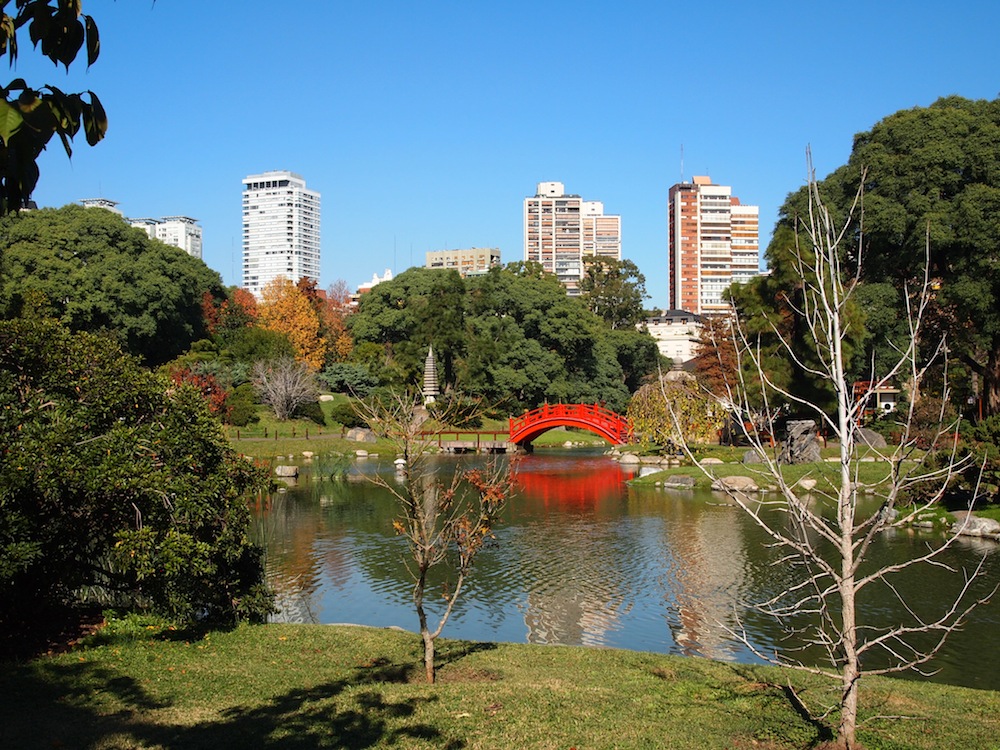
City skyline from the Japanese gardens

On Wednesday, we started the day with a visit to the Jardin Japones — the Japanese Gardens of Buenos Aires, built by the Japanese Argentine Cultural Foundation in the 1960’s. The gardens had a similar feel to the Chinese gardens and temples I visited in Beijing on my Northeastern Dialogue of Civilizations trip, and it was a bit strange to have sudden flashbacks to my 5 weeks spent in China while in the middle of Argentina. Regardless, the gardens are a beautiful green space, plus it’s always fun to see a Koi pond!

From there we walked up through Palermo to the MALBA museum, the Museo de Arte Latinoamericano de Buenos Aires. The museum is half price on Wednesdays, and students (I may still take advantage of my Husky ID) are free, which was a nice break from the rather pricey entrance and tour fees we’ve been paying throughout BA. Coincidentally, the museum had a beautiful exhibit entitled Bye Bye American Pie, featuring seven American artists of the late 1900’s: Jean-Michel Basquiat, Larry Clark, Nan Goldin, Jenny Holzer, Barbara Kruger, Cady Noland y Paul McCarthy. I’d never seen work from any of the artists, and I was lucky enough that there were English translations of almost all the descriptions so I could understand everything. I particularly loved the work by Jean-Michel Basquiat, an expressionist painter who died in 1988, at the age of 27, of a drug overdose. His work — combinations of everything from elephant drawings, repeated words written in pencil and crossed out in bright paint colors, and messages of African American history — was thought provoking, bizarre and absolutely captivating, and I truly enjoyed it.

Larry Clark‘s photographs were a bit harder to stomach — many of them were raw images that involved heavy drug use in rural America. It was interesting to think about the way America was being depicted to South Americans, but also interesting to think about the prevalent drug use in our country, especially during the 70’s and 80’s.

Erica met up with us and we left the museum to grab lunch a few blocks away, walking through the beautiful tree-shaded streets of northern Palermo, lined with huge, beautiful houses. A stark contrast to yesterday’s La Boca visit, but great to see nonetheless. I had my first tortilla — not a tortilla at all, but a Latin American version of a frittata, made with eggs, potatoes and onions. Heavy, but delicious!

After another hour and a half or so checking out the other MALBA exhibits, we wandered back toward our hostel, stopping for a delicious helado on the way. Buenos Aires has particularly good ice cream — their mascarpone flavor is to die for. I hadn’t realized what a heavy influence Italy had on South American countries, particularly in cuisine. I didn’t expect to see so much pizza and pasta!

Erica went to an architecture expo and we took a bit of a break at the B&B, then met up again to head to La Catedral — a tango milonga in an 1880’s warehouse that originally served as a silo and dairy factory.

I’m almost a loss for words to describe the La Catedral decor — one part raw and rustic, another vintage and eclectic. Mismatched tables and chairs filled the back third of the room behind the dance floor, and sofas and chairs with ripped cushions, stuffing popping out of several corners, line the walls. Artwork hangs in every available space on the 20′ walls. Bare, colored lightbulbs are wrapped precariously on a wire circle and hung directly above the dance floor, and aside from a few kitchen bulbs, a controlled spotlight, and the glow from the candles on the tables, provide the only light. My photos don’t do the space justice, since the dim light made it hard to capture, but here are a few:

A dozen couples, including the two tango teachers who we saw teaching the end of a lesson when we first arrived, took turns heating up the dance floor. Our variety of empanadas — chicken and cheese, pumpkin, caprese, and vegetable — were so good they practically melted in our mouths. Between the incredible tango dancing, live music and delicious Malbec we were drinking, I felt like I was truly experiencing Argentine culture.

Thursday we began the day in San Telmo on Defensa Street, the same avenue where the market was set up last Sunday, and where I happened to fall in love with a gorgeous leather jacket being sold by Diego, an older gentleman who owns “En la Escalera” — a leather pop-up shop that consists of a small display of beautiful jackets on a random set of stairs, tucked behind a huge metal door. Of course, he didn’t have in the right size/color combination I wanted, but luckily was very sweet and told me to be in touch later in the week. When I emailed him on Wednesday to see if he had gotten one in stock, I was in luck! He told us to come by between 12 and 2, and when we got there we discovered he had even written a special sign with my name telling me to ring the bell. He let us in and let me try on the jacket, stare at myself in the mirror, debate with Alison and Carolyn for entirely too long, and even held a lighter to the jacket to prove it wasn’t synthetic or plastic (I had never heard of this test before, but it made sense to us and seems to be legitimate) before I finally forked over my 600 pesos. Long story short: I’m obsessed with my gorgeous, fitted, black leather jacket and so glad I splurged!

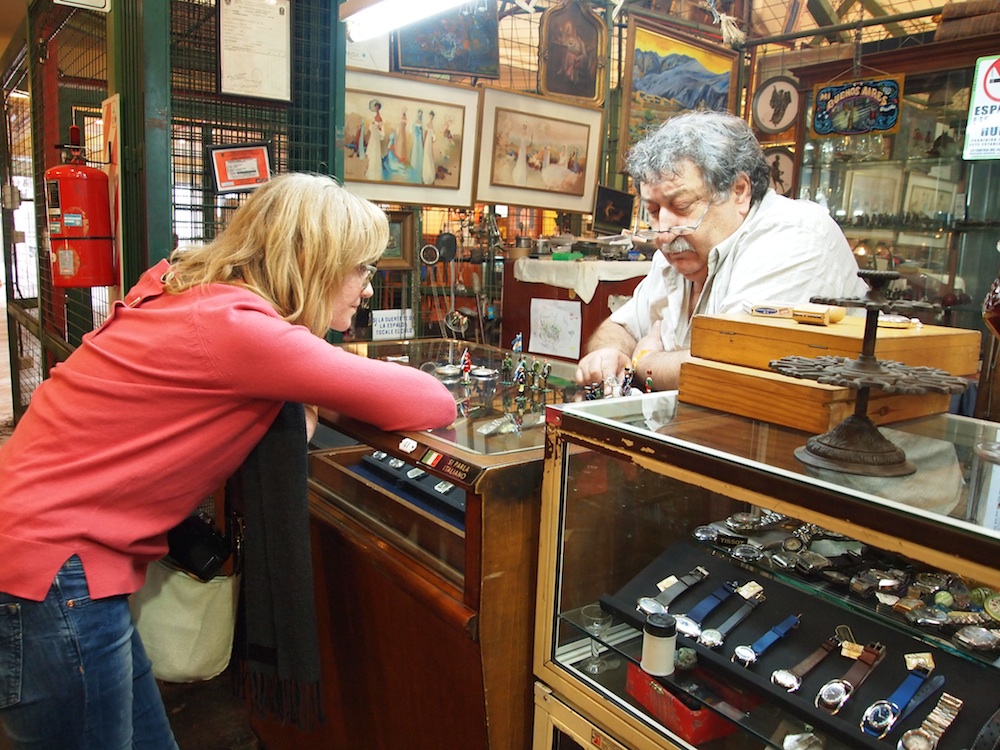
With my wallet feeling very empty but my nose filled with the scent of leather (I obviously put the jacket on that moment and refused to take it off the rest of the day), we meandered San Telmo, perused a few shops and stumbled upon a galleria — a large, open building with dozens of small store fronts selling antiques and all sorts of chachkies. When Carolyn spotted a pair of beautiful gold earrings and a large collection of hand painted toy soliders in a display, we began talking to the seller, an older, heavy-set gentleman with Italian heritage.

Our new best friend showing Carolyn the various soldier figurines

We ended up at his storefront for almost 45 minutes — he pulled out an old map and gave Alison a history lesson on Chilean-Argentine relations and colonial borders of South America. He showed us an old fashioned stamp holder (which we mistook for an earring display), let us marvel at his collection of pocket watches, for which he had a half dozen beautiful stands and holders, and even took out a dozen of the lead, hand painted toy soliders to explain to us their different uniforms and what part of Argentine history they came from.

Carolyn purchased three of the soliders as souvenirs and then we went for lunch at one of the historic cafes in San Telmo. The special of the day — a chicken, onion and bell pepper mixture that they were calling a stew but wasn’t really, served over rice — was the perfect hearty meal to warm us up, as a serious chill had set in when a cloud cover hid the sun.

We took the metro back to our area of town and did a bit more perusing of stores on Corrdoba Ave, where Alison bought a beautiful coral-colored floor length skirt.  Then we went back to our B&B to quickly change before heading to the Teatro Colôn to see the Buenos Aires Philharmonic perform. The theatre is stunningly beautiful inside and is six levels, with balconies lined along the edge of each of the levels. Our seats had a partial view so we had to lean a bit over the railing to see the orchestra, but it was a wonderful performance, and so nice to be able to enjoy beautiful classical music, even in a country where I don’t speak the language.

From there we went to dinner at La Peña del Colorado, a venue that puts on live folk music shows. We arrived at the end of the show so we only caught a few songs, but after devouring our quinoa salads we grabbed our bottle of wine and went to the back room, where a few musicians had invited us to listen to them play. They passed around guitars, a Chilean woman sang her heart out, and our new friend Diego played bluegrass on his fiddle. They alternated between conversation, soulful ballads and upbeat songs — a handful of other people joined the festivities, some playing instruments, others just listening and clapping. It was incredible to see the emotion the men and women played their instruments with, and despite getting back to our hostel at nearly 3 AM for just three hours of sleep before getting up to catch our 8 AM ferry to Uruguay, it was well worth the exhaustion!